Case studies by Jason Don of PENTASIR: AI tools, automation, and products shipped end to end.
Real problems. Real outcomes.
Automated Service Workflow
A global retail brand's workflows were handled entirely manually - creating bottlenecks, inconsistent follow through, and pulling staff away from revenue generating tasks.
Identified the bottleneck through direct operational observation, mapped the end-to-end workflow, and authored the solution spec. Managed the global rollout as UAT lead - from requirement sign-off through to staff adoption across all ANZ locations.
152 hours of productivity recovered per year - equivalent to $230,700 in value returned to front of house operations. Single-person dependency eliminated across all critical brand operations.
Fly Brain on Music - sonifying a real connectome


Connectome datasets map a brain's wiring down to the synapse, but they stay locked in research papers and raw graph files. There was no way for anyone outside neuroscience to feel what that structure actually is, only read about it.
Built a Streamlit app that maps live audio onto a real fruit fly connectome (BANC v888) and drives a leaky-integrate-and-fire neural simulation using published biological parameters (Shiu et al. 2024), rendered as a 3D glowing brain scene. What's real biology and what's a speculative mapping choice is disclosed in-app, not blurred together for effect.
Shipped solo end to end - data pipeline, simulation, 3D renderer, deploy - and open-sourced under MIT with the data committed. open it live · View the project
Compendium - a local-first reflection app
Most journaling apps want an account, a server, and a subscription for what is basically a text file. They are also write-only: thoughts go in and nothing comes back, and your most private writing ends up living on someone else's machine.
Built local-first on a single premise: most of what we think today is a recurrence of yesterday. One entry a day, written the day it happens, and the app quietly surfaces the words you keep returning to. No account, no backend, zero network calls. The same codebase ships as a web app and a native desktop app, and on the desktop every entry is a plain Markdown file you own.
A finished product on two platforms with nothing leaving the device. Open source under MIT, so the privacy claim is enforced by the browser rather than promised: the page's Content Security Policy refuses any outbound request. open it live · View the project · Read the build story
ThirstyLLM - an open source AI measurement
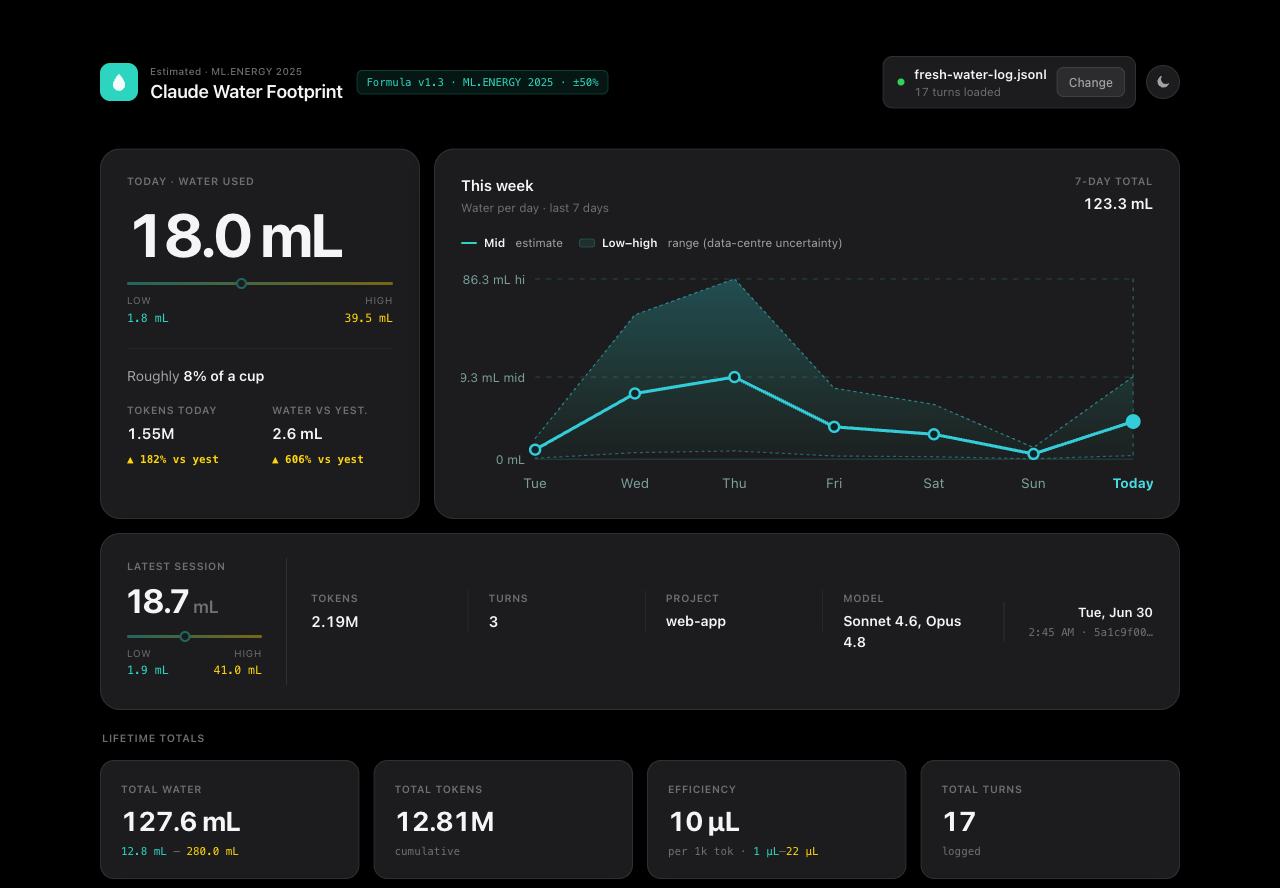
Data centres use water to cool the hardware that runs AI. There is published research on how much. There was no tool that connected those numbers to what you, specifically, were actually spending. The research itself had been built on assumptions from a different era of hardware entirely.
Built a tracker that runs offline: no API key, no network requests, nothing leaving the machine. Then, before publishing any numbers, emailed the paper's lead author to check the methodology. He wrote back. The original estimates, he said, shouldn't be applied to modern models.
The tool's own figures were revised 39 times downward and published that way, with the correspondence quoted in the methodology. A smaller number makes for a less alarming headline. It also happens to be correct. Every figure still ships as a range, because false precision is its own kind of lie. Read the build story
More case studies coming soon.
Work with me